Graphic Design
Experiential Learning
Students
Honors
Faculty and Staff

Graphic Design students learn modern print production firsthand
The Berkeley College Graphic Design Club started the semester with an industry site visit to Sandy Alexander, a high-end commercial graphic communications and marketing company located in Clifton, New Jersey. For more than four decades, Sandy Alexander has served the corporate communications, cosmetics, pharmaceutical, automotive, graphic design, advertising, and promotional industries, earning a reputation for technical expertise and high production standards.
Connecting classroom instruction to professional practice
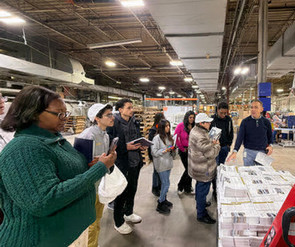 A group of students, along with the club’s faculty advisor, Professor Scott Agnoli, toured the full-service print production facility under the guidance of Wayne Angley, Director of Nightside Service. Students followed the complete print workflow, from file preparation through final output. The visit included four-color printing on digital and offset presses, as well as pre-press, bindery, production, and finishing operations. Students saw firsthand how design decisions affect print quality, timelines, and cost at scale. The experience connected classroom instruction to professional practice and reinforced print production as an important component of graphic design education.
Students benefit from the experience
 Graphic Design Club President Gabriel Pereira reflected on the experience, saying, “The visit to Sandy Alexander helped me better understand large-scale printing and how design functions within a production environment. Seeing the operation in action made our classroom learning real and showed the importance of accuracy, planning, and teamwork.”
Pereira, a student in the Honors Program at Berkeley College, recently presented his project "Has Art Lost It Soul in the Age of AI?" at the Middle States Commission on Higher Education (MSCHE) National Conference in Philadelphia.
Insight into current industry trends
Contrary to common beliefs that print is a declining industry, commercial printing continues to adapt alongside digital media and integrated marketing channels. The global commercial printing market is projected to reach approximately $598 billion by 2030, driven by demand for packaging, promotional print, and customized brand materials. As the industry evolves, employers seek designers who apply design thinking and critical thinking across systems, not designers focused only on one-off, static deliverables. Understanding how print fits within larger communication systems, from brand touchpoints to production workflows, reflects the type of interdisciplinary thinking reinforced through Berkeley College’s Graphic Design program.
Powerful, practical career education
“While classroom instruction provides the foundation, experiences like this bridge the gap to real-world application,” said Professor Julia Hutchinson, Chair of the Graphic Design program at Berkeley College. “Seeing a full-service facility like this in action, our Graphic Design students gain a better understanding of the career pathways available to them upon graduation. This level of exposure is exactly what prepares them to transition from the studio to the industry.”
The views and/or opinions in this article are those of the individuals interviewed. The academic achievements and/or employment outcomes described in this article are specific to each individual and are not a guarantee of similar results for past or current students. For up-to-date and detailed information, please visit BerkeleyCollege.edu and view our catalogs at BerkeleyCollege.edu/publications.
Related Posts

Health Services
Experiential Learning
NYC Midtown
Faculty and Staff
Newark
Students
First-generation students and staff love the closeknit feel

Students
Newark
Woodbridge
Experiential Learning
Woodland Park
Graphic Design
Alumni
First-generation students find support and success at Berkeley College

Management
Woodland Park
Berkeley College Online
NYC Midtown
Students
General Business
Business Analytics
Experiential Learning