Woodland Park
Berkeley College Online
International Students
NYC Midtown
Graphic Design
Newark

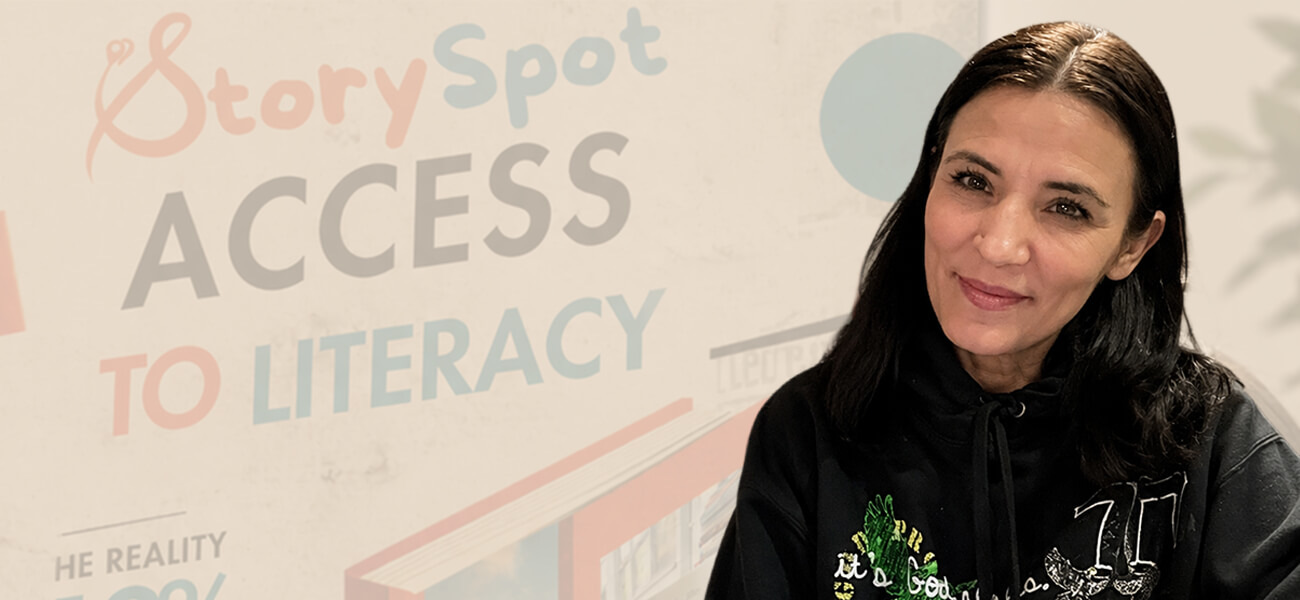
Berkeley College Graphic Design student shows passion and purpose
In the Berkeley College Graphic Design program, offered at the Woodland Park and New York City campuses and Online, the Capstone Project course is the culmination of students’ talents and turns their ambitions into a single, large-scale passion project and presentation.
We recently spoke with student Argentina Aquino about her Berkeley College journey and her inspiration.
How did you decide on Berkeley College?
Aquino: Before coming to America, I was a journalist in Albania. Education has always been in my DNA. I have always had this curiosity and desire to learn something new, to educate myself, and to continue growing.
Creativity is also simply part of who I am. I have expressed myself through journalism, poetry, painting, design, sewing, and making clothing. I always say that I see art in almost everything my eyes touch. I see possibilities, what something is, but also what it could become. After the pandemic, I felt that it was time to do something for myself and further my education. I knew I wanted to explore Graphic Design because it brought together so many things I already loved: art, storytelling, communication, problem-solving, and creativity. At the time, I honestly didn't know very much about Berkeley College. I started doing my research and submitted an inquiry. Shortly afterward, Admissions reached out to me.
Their patience and compassion made such an impression on me. They took the time to answer my questions and guide me through the process, and before I knew it, I had all the information I needed. More importantly, I felt comfortable. I felt welcomed. Something inside me said, this is the place. Looking back, I can say that the care I experienced during admissions was not just part of the recruitment process. It has been part of my Berkeley College experience throughout my education.
Without a doubt, choosing Berkeley College was one of the best decisions I could have made, and I feel fortunate that my journey brought me here.
How do you feel you've evolved as a student at Berkeley College?
Aquino: I came to Berkeley College as a creative person, but Berkeley helped me understand what it means to become a designer. Before, I might look at something and think about how I could make it beautiful. Now I ask: Who am I designing this for? What problem am I solving? What am I communicating? How will someone experience it? And why does it matter? That change in thinking has been one of the greatest parts of my education.
I have also evolved personally. I did not take the traditional path to college. I returned to school as an adult, while working, raising a family, and carrying all the responsibilities that come with life. There were days when I honestly did not know how I was going to manage everything. But I kept going. Berkeley challenged me creatively and academically, but it also taught me something about myself. I learned that growth doesn't have an age or a perfect timeline. Sometimes you discover another part of yourself simply because you were brave enough to keep learning.
I am still the journalist, the writer, the poet, the painter, the person who loves fabric and making clothing. Graphic design did not replace those parts of me. It brought them together and gave me another language through which to tell stories.
Do you feel that you're preparing to enter the professional world?
Aquino: Yes, absolutely. In many ways, I feel that I am already bringing what I have learned at Berkeley College into the professional world and into my community. I learned how to take an idea from concept to execution. I learned how to research, present an idea, accept criticism, revise my work, defend my design decisions, solve problems and, sometimes, completely start over. Most importantly, I learned that being a designer carries responsibility. We are communicating with people. We can make information easier to understand, make someone feel included, tell a story that might otherwise go unnoticed, or design something that responds to a real need. That is the kind of designer I want to continue becoming.
What do you like most about the Graphic Design program?
Aquino: The professors. Of course, I value everything I learned technically, but what I will remember most are the people who taught me. My professors did more than teach me how to use design programs. They challenged me to think. They pushed me when they knew I could do better, and they encouraged me when I needed encouragement. Professors Benjamin Hoyng and Julia Hutchinson, especially through my Capstone journey, had an incredible impact on me. They did not simply tell me what to create. They helped me discover what I wanted to say. There is a big difference between a professor who teaches you an assignment and a professor who helps you see something in yourself that you didn't fully recognize yet. I have been fortunate to experience that at Berkeley.
Please tell us a little about your Capstone project.
Aquino: My Capstone was more than a project. It became StorySpot. StorySpot began with a very simple belief: Access to books shouldn't be a privilege. The idea began during a one-on-one class meeting with Professor Julia Hutchinson. We were talking about possibilities for my Capstone, and somewhere within that conversation, an idea started to form around something very close to my heart: children, literacy, and access to books. Through my work in an elementary school in Newark, I see children and families every day. I understand that not every child has the same access to books or the same opportunities to develop a relationship with reading. I started thinking: What if, instead of always asking children to come to the books, we brought the books to where the children already are?
That question became StorySpot, an outdoor mini-library and reading experience designed to bring books directly into school playgrounds, parks, and community spaces, places where children already gather, play, and feel comfortable. But StorySpot is also much more than placing books on a shelf.
For my Capstone, I developed it as a complete branding and design system. I researched childhood literacy and access to books. I developed the concept, strategy, name, visual identity, logo, typography, color system, messaging, signage, promotional materials, physical structure, and the overall experience.
Every design decision came back to one question: How can we make access to reading feel welcoming, joyful, and natural? With the guidance and support of Professors Hutchinson and Hoyng, StorySpot continued to evolve. There were many conversations, revisions, questions, moments of doubt, and moments when something finally clicked. They challenged me to look deeper and helped me understand that the strongest design is not necessarily the most beautiful design; it is the design that has a reason to exist. Then something amazing happened. StorySpot moved beyond my computer screen.
It was piloted at First Avenue School in Newark, where I work, with books provided through Books in Homes USA. StorySpot continues to serve students and families today by providing access to books and encouraging children to engage with reading in an accessible and welcoming environment. Seeing children actually interact with StorySpot was probably one of the most rewarding moments of my entire Capstone journey. And my final presentation at Berkeley did not become the end of StorySpot.
After the presentation, I had a meeting with the Newark Literacy Coalition and Books in Homes USA. We began discussing the possibilities of expanding StorySpot beyond the school pilot and potentially placing physical StorySpot libraries on playgrounds throughout Newark, one playground at a time. There is something difficult to describe about the joy and pride I feel knowing that an idea that began during a one-on-one class conversation at Berkeley College could potentially continue growing and reaching children and families in my community.
I don't know yet how far StorySpot will travel. But I know where it started. StorySpot taught me perhaps the most important lesson of my Graphic Design education: Design can create access. It can solve problems. It can tell stories. It can connect people. And when design is created with purpose, it can become a tool for change.
What would your dream job be in the future?
Aquino: This is actually a difficult question for me because I don't think my dream fits neatly into one job title. I want to create. I want to be somewhere where design, storytelling, art, culture, education and community come together. I would love to continue growing toward creative direction and strategic design, where I can develop not only the visual piece of a project, but the idea and purpose behind it. Whether that happens within the arts, education, a cultural institution, a nonprofit organization, or perhaps one day through something I create myself, I want my work to mean something.
Any advice for younger students considering a career in Graphic Design?
Aquino: Stay curious. Learn everything you can. Learn the software, understand typography, study design, ask questions, and listen to your professors, but don't allow a program or a computer to define your creativity. And don't be afraid if you haven't discovered your "style" yet. You are still becoming. Allow yourself to experiment, fail, change your mind, start again, and grow. Find something you care about and design from there. When you care about what you are creating, the project stops being just an assignment. It becomes part of you.
Her professor saw something special
“Argetina was a wonderful student in the online Capstone project course,” said Professor Hoyng. “Her project was unique in how she approached her life experiences as a working educator, mother, and creative into a human-centered design concept to help improve literacy rates in Newark. She works within the public school system, and inspiring reading, writing, and creativity in young people is her passion. The Capstone project course was her channel to develop her own creative direction, not just for the course, but for her post-graduate future both professionally and creatively.”
“I first met Argetina when she was enrolled in an online Painting course,” Hoyng remembered. “It’s been wonderful to see how her work has evolved from foundational, freshman-level studies into a polished and professional design presentation with a senior-level course like the Capstone project. She’s incredibly talented.”
Helping students reach their full potential
“The Berkeley College Graphic Design degree program stands out in many ways,” according to Hoyng. “We teach our students the latest industry software and technology, AI-preparedness, foundational art and design studies, and a relevant, industry-standard curriculum.” He emphasized, “Our priority is to always put the student first. Both on-site and online, we visit and provide feedback with our students every single week, throughout the week. Our close faculty and student relations in the Graphic Design program are one of our key strengths.”
The views and/or opinions in this article are those of the individuals interviewed. The academic achievements and/or employment outcomes described in this article are specific to each individual and are not a guarantee of similar results for past or current students. For up-to-date and detailed information, please visit BerkeleyCollege.edu and view our catalogs at BerkeleyCollege.edu/publications.
Related Posts
Graphic Design
Experiential Learning
Students
Honors
Faculty and Staff
Graphic Design students learn modern print production firsthand
Students
Newark
Woodbridge
Experiential Learning
Woodland Park
Graphic Design
Alumni
First-generation students find support and success at Berkeley College
Alumni
Legal Studies
Management
Students
Criminal Justice
General Business
Fashion
NYC Midtown
International Business
Graphic Design
Applied Media
Interior Design
Health Services